
What is killing the hemlocks?
Eastern and Carolina hemlocks across Western North Carolina have been dying from hemlock woolly adelgid, a tiny invasive insect from Asia. The adelgid feeds at the base of the needles and slowly starves the tree. Without treatment, an infested hemlock usually declines over several years until it dies.
Signs of hemlock woolly adelgid
- White, cottony tufts on the underside of the twigs, at the base of the needles. They are easiest to see in late fall through spring.
- Gray or yellowing needles and needles dropping, starting in the lower branches.
- Little or no new growth on the branch tips in spring.
- Thinning crown, where you can see more sky through the tree each year.
Why dead hemlocks are a risk
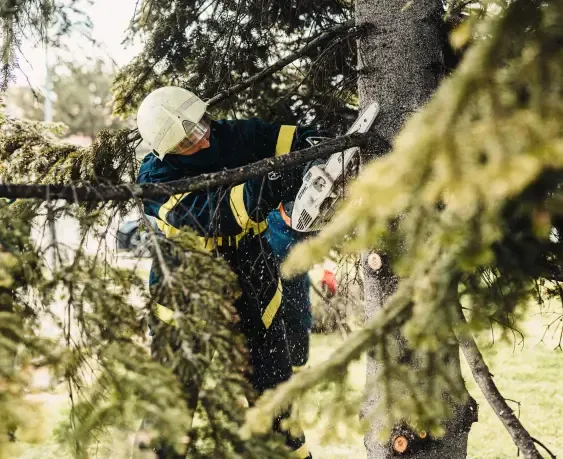
Once a hemlock dies, the wood dries out and gets brittle. Dead hemlocks are known for dropping their tops and large limbs without warning, and for snapping in wind and ice. That also makes them harder and more dangerous to climb the longer they stand. If a dead hemlock is close enough to hit your house, driveway, power lines or a path, it is usually safer and cheaper to remove it sooner rather than later.
Already brittle? We plan dead-hemlock removals around the condition of the wood. Brittle wood can mean more rigging and smaller pieces, and we look at that before we quote.
Your options
Still mostly green: the tree may be saved. Treatment by a licensed pesticide applicator can protect hemlocks for several years at a time. Ask about it before the tree loses most of its needles.
Thin and declining: treatment may still help, but the tree may also have dead limbs that should come out now. A tree health assessment will tell you where it stands.
Dead, near something it can hit: plan a removal. We take it down in sections, chip the brush and haul the wood or leave it as firewood.
Dead, deep in the woods: it can often be left as wildlife habitat, as long as it can’t reach anything.
Where we see it most
We find dead and declining hemlocks all over our service area, especially on shady, north-facing slopes and along creeks, where hemlocks grow best: around Black Mountain, Swannanoa,East Asheville and Leicester.